
Importance of Regulatory Compliance in Third Party Contract Manufacturing
Browse 3,500+ WHO-GMP certified PCD pharma companies offering monopoly franchise rights across all 28 states. Compare pricing, products & territory — for free.
Our expert connects you with the best PCD company within 24 hours
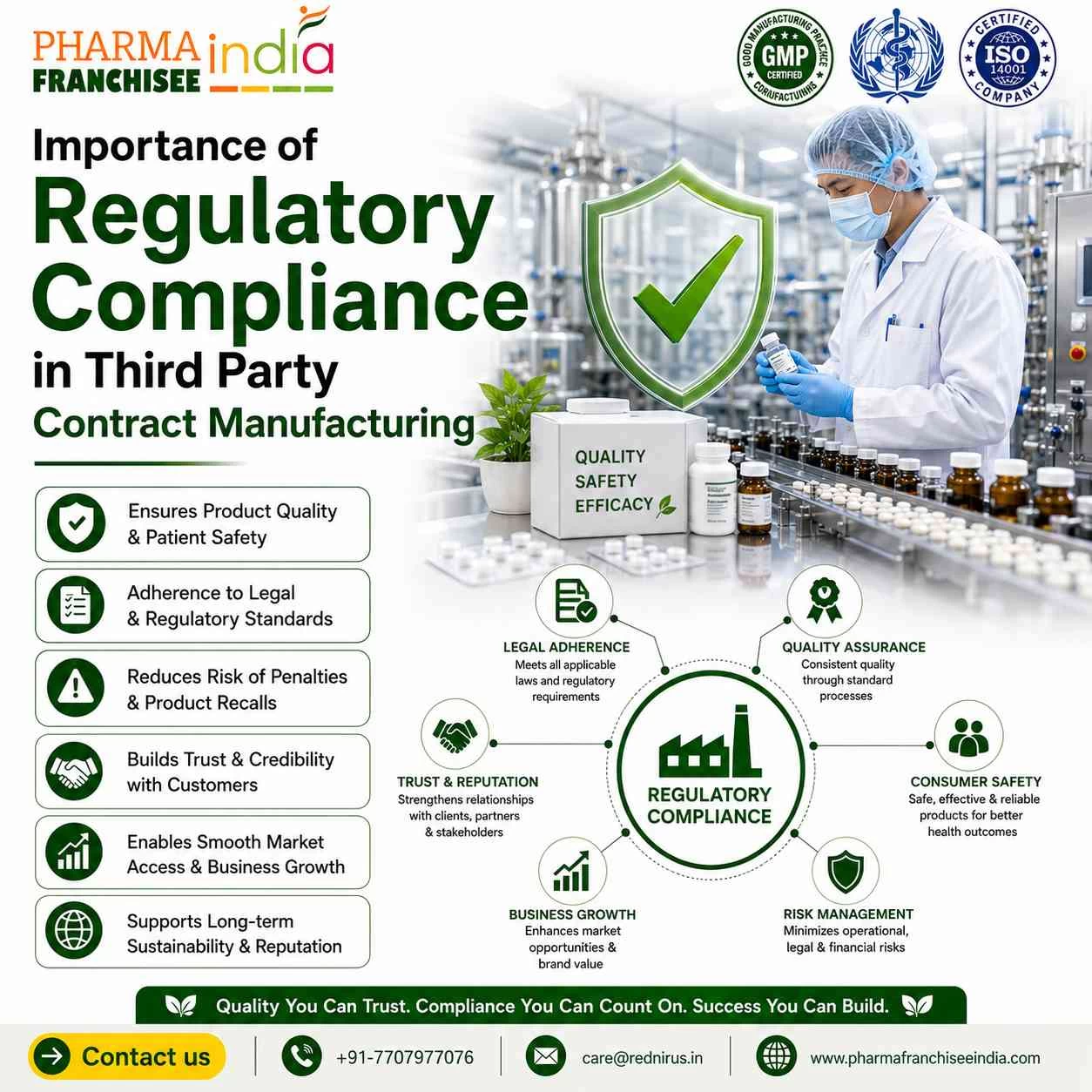
The role of Third Party Contract Manufacturing in the pharmaceutical industry in India cannot be overstated since brands can utilize specialized facilities for manufacturing their products by outsourcing the process and concentrating on sales and marketing of the products. With more and more businesses opting for 3rd Party Contract Manufacturing due to increased efficiencies in scaling up, regulatory compliance has now come to be viewed as the most important criterion that determines whether a partner is trustworthy or not. Irrespective of whether your business is looking at starting with 3rd Party Contract Manufacturing or finding a new manufacturer, the need for regulatory compliance cannot be overlooked.
What is Regulatory Compliance in Pharmaceutical Contract Manufacturing?
The term Regulatory compliance in the context of Pharmaceutical Contract Manufacturing means the compliance of a manufacturing unit with all the rules and regulations laid down by the authorities like CDSCO, WHO, and even the State drug licensing bodies. It means that the manufacturing process is regulated with respect to raw material procurement, plant hygiene, batch documentation, quality control analysis, packaging, and every other step involved in the process.
Third Party Manufacturers need not just ensure compliance in terms of a tick box list – but it is a commitment which shows their professional attitude. The company ensures that all the GMP certificates, DCGI approval, and Schedule M compliance along with proper documentation of every kind of drug category they manufacture. When you associate yourself with a compliant facility, you basically safeguard your brand name and license.
Why do Contract Manufacturing Companies Prioritise GMP and DCGI Certifications?
One of the most crucial aspects of assessment for Contract Manufacturing Companies includes certification. WHO-GMP certification denotes that the facility is compliant with international norms for cleanliness, machine calibration, quality control system, and training of staff. DCGI certification denotes that the manufacturing facility has legal authorisation to manufacture certain categories of products in India.
The importance of these certifications can be understood from the following points:
• Product Safety: The GMP certified plants use SOPs that avoid any kind of contamination or cross-contamination of products.
• Export to Regulated Markets: Regulatory certifications are a must requirement for exporting to regulated markets, such as US, EU, and Southeast Asian nations.
• Legal Protection: A legal licence offers protection to the brand owner and the contract manufacturer from possible drug recall or notice for not complying with regulations.
• Credibility of Brands: Certifications create credibility in the minds of distributors, retailers, and consumers.
India's best pharma CMCs based in pharmaceutical hubs like Baddi, Haridwar, and Ahmedabad continue to upgrade their facilities to maintain and renew these certifications.
How does Non-Compliance Affect Third Party Manufacturing Operations?
Non-compliance in Third Party Manufacturing leads to various repercussions that could prove detrimental for everyone involved in the process. Regulatory bodies could order suspension of manufacturing licenses, recall orders, and imposition of hefty fines in cases of non-compliance in a pharmaceutical manufacturer. If the pharma products manufacturer uses the services of any 3rd party, then it will have to face shortages, loss of reputation, and monetary losses to the tune of crores.
Risks arising out of Non-compliance in Third Party Manufacturing can be listed as:
• Supplying substandard or contaminated goods.
• Batch failures due to poor quality control procedures.
• Non-delivery due to non-obtaining of requisite permission.
• Losing the distribution franchise due to quality issues.
• Imprisonment under the Drugs and Cosmetics Act, 1940.
Selecting Non-compliant Pharmaceutical Contract Manufacturers solely based on pricing considerations is an extremely costly decision for a pharmaceutical company.
What Should You Check Before Selecting a 3rd Party Contract Manufacturing Partner?
It is crucial to conduct due diligence before signing off on any Pharma Contract Manufacturing arrangement. The due diligence process will enable you to ascertain compliance status and evaluate the sustainability of the facility. The following checklist provides a systematic way forward:
• Up-to-date WHO-GMP Certificate: Verify that the certificate is current and includes categories of drugs needed.
• State Drug Licenses and DCGI Approvals: Double-check with local state drug regulators regarding the status of licenses and approvals.
• Compliant with New Schedule M: Determine that the facility follows requirements set out in Schedule M for facilities.
• Qualified Person (QP): There should be a Qualified Person present in the company who manages batch release.
• Analytical Laboratory within the Company: This facility is essential for conducting stability tests, microbiological tests, and batch release.
• History of Prior Regulatory Inspections: Ask for prior inspection reports and CAPA's from regulatory inspections.
• Batch Production Records: These records prove compliance and proper documentation procedures.
Working with only Top Pharma Contract Manufacturing Companies that provide audit results and an open-book quality system will greatly reduce risks associated with compliance.
How are Top Pharma Contract Manufacturing Companies Raising Compliance Standards?
India's Leading Pharmaceutical Contract Manufacturing Companies have started preparing themselves proactively with regard to compliance and are no longer waiting to be audited by the authorities. The motivation behind the move is an increase in demand for pharmaceutical products internationally, increased enforcement by the CDSCO, and increased awareness among local pharma companies regarding the significance of supply chain quality.
The following are some compliance enhancements adopted by India's top units in the industry:
• Electronic Batch Recording Systems (eBMR): Moving away from manual documentation to a computerized system that allows real-time recording of information.
• Environmental Monitoring Program: Real-time continuous air monitoring and surface monitoring in sterile and non-sterile production facilities.
• Annual Product Quality Review (APQR): Analyzing batch data and deviations and complaints made by customers in order to determine any improvement trends.
• Supplier Qualification Program: Auditing suppliers to ensure that all parties along the supply chain comply with regulations.
• Training Calendar for Employees: GMP training for all employees working at production, quality assurance, and warehousing units.
By adopting such proactive measures, these Contract Manufacturing Companies will prove to be more reliable compared to units that only have a license.
Frequently Asked Questions (FAQs)
Q1. Which certifications must a good Third Party Manufacturer have?
Ans: A trustworthy Third Party Manufacturer must have a valid WHO-GMP certificate, an active drug manufacturing license by the State FDA, DCGI approval for drug categories applicable to them, and Schedule M compliance certificates. This assures that the unit complies with quality standards in the country and internationally.
Q2. In what ways will regulatory compliance in 3rd party contract manufacturing help the brand owner?
Ans: Brand owners would be protected against product recall, legal action, and any other form of damage to their reputation through regulatory compliance. This will ensure product consistency, entry into regulated markets, and avoiding any sort of risk to the operations.
Q3. Is it true that all pharmaceutical contract manufacturing companies in India hold WHO-GMP certification?
Ans: It is incorrect that all the pharmaceutical contract manufacturing companies operating in India have WHO-GMP certification, when many of them operating out of pharmaceutical cities such as Baddi and Haridwar have. It is necessary to check the certificate of a unit before going ahead with any manufacturing.
Conclusion:
Compliance is not an accessory in the realm of Third Party Contract Manufacturing – it is the backbone that helps produce a safe, efficient and legal drug. Every single compliance aspect, from WHO-GMP certification, DCGI approval, robust quality management systems to proper documentation, plays an important role in safeguarding patients, brand owners, and the entire healthcare environment.
When selecting Third Party Manufacturers for your product range, make compliance an essential part of the selection criteria instead of treating it as secondary. Any temporary savings you may earn by choosing a non-compliant manufacturer will pale in comparison to the future risks involved in working with such units. Always work only with the best pharma contract manufacturing companies that take compliance seriously and use it as an advantage.
Must Read: Best Cardiac Diabetic Products Franchise in India: Investment, Profit & Growth Potential

Author : Surinder Thakur
Surinder Thakur has closely worked in the PCD franchise field for more than 20 years. With a background in pharmaceutical marketing, he understands both medicine and the business behind it. Through Pharmafranchiseeindia.com, he shares practical and honest guidance to assist pharma professionals make better decisions.